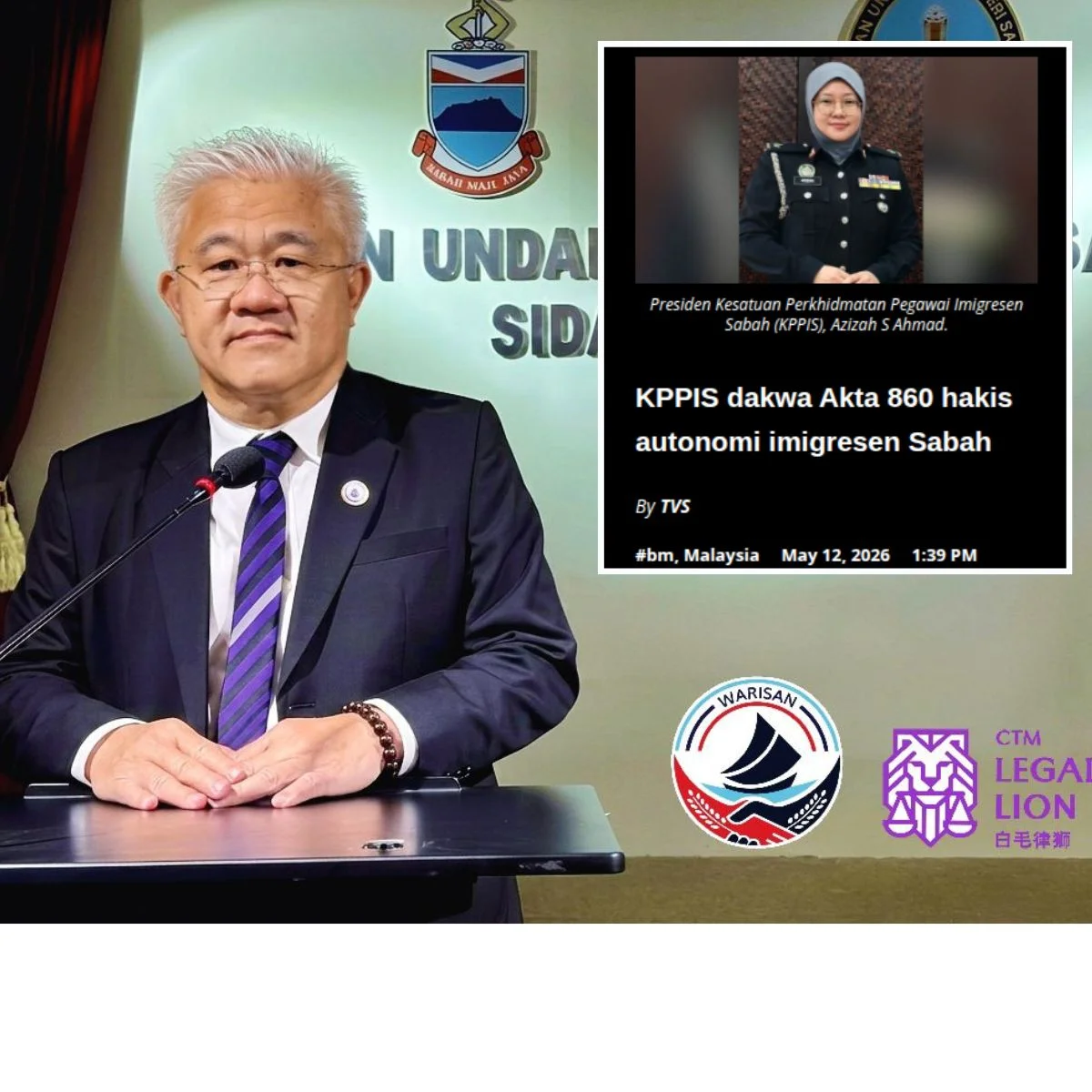
KOTA KINABALU: N.25 Kapayan Assemblyman, Chin Tek Ming views seriously the concerns raised by the Sabah Immigration Officers Services Union (KPPIS) regarding the implementation of the Malaysian Border Control and Protection Agency Act 2024 (Act 860 / AKPS).
According to him, concerns raised by Sabah immigration officers themselves cannot be taken lightly, as they are at the frontline of border enforcement and better understand the operational realities on the ground.
He said that when concerns arise that Act 860 could erode Sabah’s autonomous powers, create overlapping jurisdictions, and blur the boundaries of authority between the state and the Federal Government, then the State Government is obliged to provide a full explanation to the people of Sabah.
He explained that Act 860 establishes the Malaysian Border Control and Protection Agency (AKPS), a Federal mechanism that coordinates various national border control functions including immigration, customs, quarantine, security, and border enforcement.
According to Chin, although coordination of border enforcement may in principle appear beneficial, the main question for Sabah is whether such a move will ultimately lead to the centralisation of Federal powers over areas that have long enjoyed special protection under MA63 and the Federal Constitution.
He stated that Sabah holds a special position in matters concerning immigration and entry control, and that such powers are not political privileges but constitutional safeguards established during the formation of Malaysia.
He further stressed that these concerns are not baseless, as Sabah has long faced problems involving illegal immigrants (PTI), cross-border smuggling, document forgery, and security pressures in border areas such as Pulau Sebatik.
He added that Sabah also has a history of gradually losing powers to the Federal Government since the formation of Malaysia in 1963.
According to him, several Sabah ordinances that were originally under state jurisdiction had been taken over and placed under Federal jurisdiction, including the Excise Ordinance 1959 and the Petroleum Ordinance 1960.
He said that although certain Sabah ordinances remain as state laws, such as the Sabah Land Ordinance, the people are now beginning to see a worrying pattern in which state powers are gradually centralised and Sabah’s jurisdiction continues to shrink.
Chin stated that if the matter is not addressed immediately and firmly, Sabah risks losing more control over its own strategic affairs.
He also reminded that this issue is not merely a technical administrative matter but concerns Sabah’s future, including land ownership, state demographics, security, employment opportunities, and the identity of Sabahans themselves.
According to him, when border control weakens and the lines of authority between the state and Federal Government become increasingly blurred, Sabah could eventually lose control over its land and social structure.
In this regard, he stressed that the State Government cannot remain silent and must immediately clarify the actual implications of Act 860 on Sabah’s immigration powers.
He also urged that Sabah’s official position be tabled in the State Legislative Assembly, in addition to obtaining clear legal clarification regarding the boundaries of state and Federal powers.
He said the government must also ensure that there is no implementation that undermines Sabah’s special powers under MA63.
He stressed that Sabah is not merely an ordinary administrative unit but a founding partner of Malaysia, and Sabah’s rights must not be gradually reduced through new administrative mechanisms without the consent and serious scrutiny of the State Legislative Assembly.
He stated that he would continue raising the issue, including in the State Legislative Assembly if necessary, because the people of Sabah have the right to know what is happening to their state powers.