Essential Food Prices Still High: Luyang Assemblyman Calls for Comprehensive Reform of Sabah’s Food System
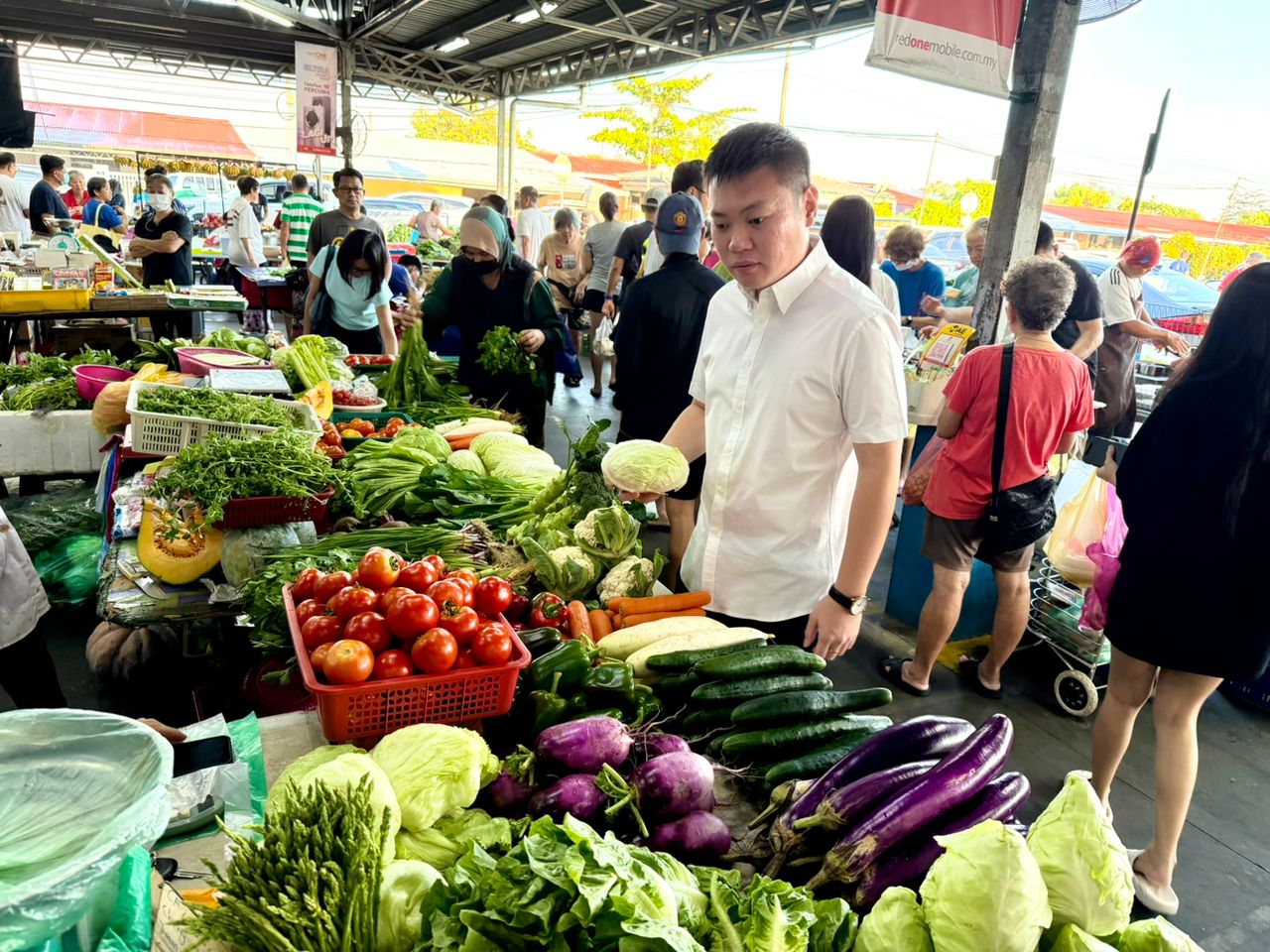
Luyang Assemblyman Samuel Wong has called for urgent and structural reforms to Sabah’s food system, stressing that the prices of essential food items particularly chicken, eggs and vegetables remain significantly higher than in Peninsular Malaysia despite ongoing government initiatives.
Speaking after recent visits to local morning markets and supermarkets, Wong said he observed that food prices have remained persistently high for many years, placing continuous pressure on ordinary households.
He noted that chicken and egg prices in Sabah are still at least one to two times higher than those in West Malaysia. As an example, the recent price of a tray of 30 Grade C eggs in Kota Kinabalu supermarkets is around RM14 to RM15, whereas in Kuala Lumpur, the same grade is selling at approximately RM6 to RM7 per tray. He stressed that this disparity cannot be attributed solely to temporary global disruptions.
“This is not a short-term issue caused by external factors. Even without ongoing geopolitical tensions affecting global supply chains, food prices in Sabah have remained high for a long time. This clearly points to deeper structural problems within our own system,” he said.
Wong was responding to remarks by Sabah Minister of Agriculture, Fisheries and Food Industries Jamawi Jaafar regarding efforts to reduce Sabah’s heavy reliance on imported animal feed, which currently stands at 98 per cent. While welcoming the initiative, including the development of commercial corn farming, Wong emphasized that such measures must go beyond announcements and be implemented effectively to deliver tangible results.
“I welcome the direction taken to reduce dependence on imported feed. However, the key question is whether these initiatives can genuinely lower production costs and translate into lower prices for consumers,” he said.
Wong added that targeted local corn development can play a role if implemented properly, particularly through designated large-scale planting zones, coordinated farming clusters, and guaranteed offtake arrangements linked directly to feed mills. Without such structure, he cautioned, isolated or small-scale projects would have limited impact on Sabah’s heavy reliance on imported feed.
At the same time, he stressed that Sabah should not rely on corn alone, but instead diversify the use of local feed resources such as palm-based by-products, cassava, rice bran, Black Soldier Fly larvae and other viable alternatives that can partially substitute imported ingredients and reduce overall feed costs.
He further stressed that focusing on production alone would not be sufficient if underlying cost structures remain unaddressed. According to Wong, logistics and supply chain inefficiencies continue to be major contributors to Sabah’s high food prices, with added costs incurred at multiple stages from transportation to distribution.
“The issue goes beyond how much we produce. It involves the entire chain from farming, feed supply, logistics, to market distribution. If these costs are not addressed holistically, prices will remain high regardless of production increases,” he said, adding that improvements in bulk handling, transportation efficiency and distribution systems are crucial to lowering costs.
Wong also called for the development of a Sabah-based feed milling ecosystem, where feed processing, supply and livestock production are better integrated within the region. Such an approach, he said, would reduce reliance on imports and external supply chains while strengthening local industry capacity.
He also highlighted broader concerns over Sabah’s food security, noting that the state remains heavily dependent on imports not only for feed but also for staple and essential food items. He pointed out that rice self-sufficiency levels remain low, while a significant portion of vegetables continues to be imported, including from China.
“This level of dependence makes Sabah highly vulnerable. We cannot ignore the risks posed by global uncertainties. Food security must be treated as a priority, not just in terms of supply, but also affordability,” he said.
Emphasizing Sabah’s natural advantages, Wong noted that the region possesses vast and fertile land that remains underutilised. He urged the government to fully capitalize on these resources to strengthen local production capacity and reduce reliance on imports.
“Sabah is blessed with land and natural resources that many regions do not have. We must make full use of this advantage. In the long run, we should not only aim for self-sufficiency, but position Sabah as a competitive food-producing and exporting region. Sabah has full potential not only in upstream agriculture, but also in downstream food industries, including processing, value-adding and manufacturing. Other countries have successfully built strong agro-food industries, there is no reason Sabah cannot do the same. The question is whether there is sufficient political will to drive this transformation,” he added.
Wong concluded by calling for a comprehensive and coordinated approach to reform the entire food ecosystem, stressing that isolated or short-term measures would not be enough to bring lasting change.
“Sabahans deserve affordable and quality food. It is time for a serious, system-wide effort to address the root causes from production and feed to logistics and market costs, so that we can finally bring down food prices in a sustainable way,” he said.