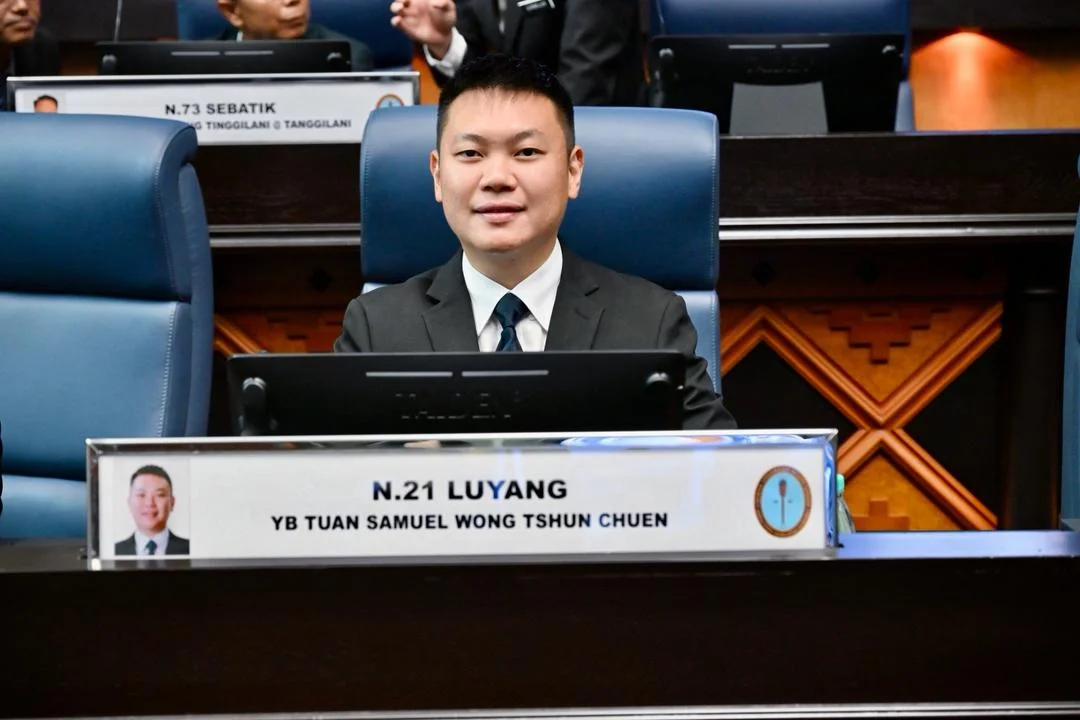
KOTA KINABALU, April 2026 - The Luyang assemblyman in the Sabah State Assembly (DUN) debate session today raised various basic issues of the people that he claims have still not been resolved despite billions of ringgit allocated every year.
In his debate speech, he questioned the effectiveness of state development implementation when the people still face problems such as damaged roads, water and electricity disruptions, non-functioning street lights, and rising living costs.
According to him, this situation shows that Sabah is still trapped in a "budget cycle, promise cycle, and cycle of unresolved problems."
"If after years and billions of ringgit spent, the people are still struggling with basic issues, this is no longer a normal challenge, this is a recurring failure," he said.
He also raised issues regarding infrastructure and public facilities in the Luyang area, including damaged street lights in several locations such as Taman Fortuna, Lorong Rampai, Taman Lido, areas near Queen Elizabeth Hospital 1, and Taman Foh Sang.
In addition, he stated that residents in Kepayan Ridge Flats, Luyang Phase 11, Jalan Angsa, and Lorong Siamang are facing low water pressure and months-long water supply disruptions, with some only receiving supply at midnight.
Frequent electricity disruptions in the Lido area, Taman Foh Sang, Taman Ria, and Taman Cantek were also raised, along with issues of poorly maintained drainage systems that lead to mosquito breeding and an increase in dengue cases in several areas.
He also emphasized that public safety issues in the Foh Sang commercial area need immediate attention, especially the elevated pedestrian walkways which have reportedly caused dozens of falls involving the elderly over the past year.
In terms of the economy, the Luyang assemblyman stated that the people of Sabah continue to be burdened by rising prices of basic food items such as eggs, chicken, vegetables, and pork, which he claims are more expensive compared to Peninsular Malaysia.
He described Sabah's high dependence on food imports and agricultural inputs as one of the main causes of this problem.
In this regard, he urged the government to strengthen the entire food supply chain, including livestock feed, fertilizers, agricultural logistics, and distribution systems.
He also recalled the implementation of the 10-year agricultural blueprint during the Warisan administration in 2019 and questioned the continuity of that plan at present.
According to him, Sabah needs to increase local production, reduce imports, and build more local brands so that the state can become a regional food exporter.
Touching on industrial and youth issues, he said many young people from Sabah are forced to migrate to Kuala Lumpur, Singapore, and abroad due to a lack of quality job opportunities in their own state.
He stated that the concerns of today's youth are not just about jobs but also involve the ability to own homes, life stability, and opportunities to build a future in Sabah.
He proposed more serious development in downstream industries, the manufacturing sector, the digital economy, and creative industries, in addition to strengthening key sectors such as oil and gas, agriculture, tourism, and natural resources.
He also called on the government to build a youth entrepreneurship ecosystem through access to financing, business mentoring, and market platforms to help young people create their own jobs.
In the tourism sector, the Luyang assemblyman stated that Sabah has great potential but still lacks new tourism products and activities that can attract tourists to stay longer.
He suggested the development of a Sabah food festival, agro-tourism, extreme sports, music and arts festivals, international e-sports, and global standard events to make Sabah a regional event hub.
At the same time, he emphasized that the issue of illegal tour operators needs to be addressed comprehensively through surprise inspections and stricter enforcement actions.
He also raised the issue of urban cleanliness, including garbage, smoking in restaurants, and the increasing problems of rats and cockroaches, which he claims undermine the city's image and public health.
In the health sector, he described Sabah's health system as currently under serious pressure due to a shortage of doctors, hospital congestion, and the use of outdated equipment.
He stated that Queen Elizabeth Hospital 1, as the main referral hospital for the state, is now facing continuous pressure, including a doctor-to-population ratio of about 1:800.
The Luyang Health Clinic was also reported to be experiencing the same problem, with patients having to wait for hours to receive basic treatment, in addition to a lack of seating and parking.
According to him, the reduction of incentives for doctors in Sabah undermines efforts to attract and retain medical personnel in the state.
He urged the state government to provide a more competitive incentive scheme to attract more doctors from Peninsular Malaysia to serve in Sabah.
The Luyang assemblyman also touched on the demand for 40 percent of Sabah's revenue, which he claims has still not found a clear resolution despite being discussed for a long time.
He requested that a motion related to that demand be officially presented in the State Assembly to allow for the government's position and direction to be decided transparently.
Concluding his speech, he said that the people of Sabah do not ask for anything extraordinary; instead, they just want basic facilities to function well and a more secure future.
"Sabah is not lacking in potential and resources. What we lack is not resources, but political will and the ability to plan Sabah's future in the long term," he said.