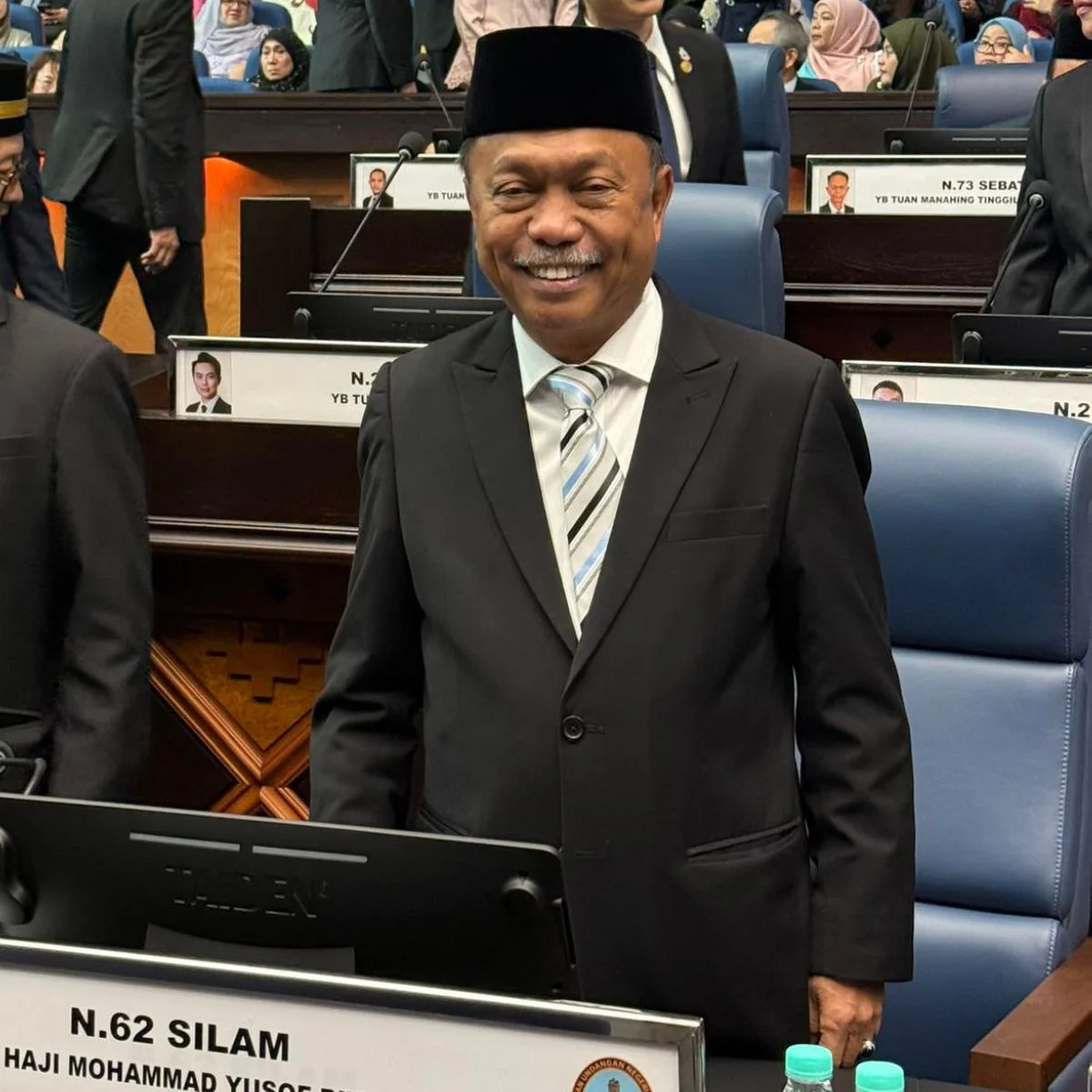
KOTA KINABALU, April 2026 - Member of the State Assembly (ADUN) for Silam, YB Dato' Dr. Haji Mohammad Yusof Bin Haji Apdal urged the state government to take more aggressive steps in strengthening Sabah's economy through the development of high-value petroleum industries, educational reforms, improvements in the tourism sector, and the acceleration of the parliamentary redistricting process in the state.
While debating the Government's Policy Speech Motion by the Speaker of Sabah 2026, he stated that Sabah cannot continue to rely solely on an extraction economy, but must shift towards a value-added economy that can provide greater benefits to the people of the state.
According to him, the government needs to immediately study the necessity of establishing a Strategic Petroleum Reserve on the East Coast of Sabah to ensure the state's energy sovereignty, especially during periods of global market uncertainty or oil supply disruptions.
He said that Sabah and Sarawak are major contributors to the country's petroleum revenue, yet the emergency storage capacity in the region is still limited because most existing terminals only function for operational and export purposes.
He also emphasized that Sabah can no longer remain as a "pump station" that merely exports crude oil without enjoying the added value from the downstream industry.
In this regard, he proposed the construction of an oil refinery on the East Coast of Sabah, particularly in Lahad Datu, given that new oil discoveries are now more concentrated in the Sulu Sea area and the maritime borders near Lahad Datu and Tawau.
He stated that the development of the refinery would not only help bridge the economic gap between the West Coast and East Coast of Sabah but also has the potential to make Lahad Datu a new petroleum hub that can attract foreign investment.
He said the existence of high-value industries on the East Coast would also indirectly enhance maritime security control in the ESSZONE area.
Furthermore, he mentioned that the development of downstream petroleum industries is crucial to prevent the migration of skilled labor from Sabah to Peninsular Malaysia and abroad due to a lack of quality job opportunities in their own state.
Meanwhile, he stated that modern technology enables Sabah to lead in green technology within the petroleum industry through the use of Carbon Capture, Utilisation and Storage (CCUS) technology and Deep Tech.
He also opined that petroleum processing in Sabah would increase the economic value added to the state and directly strengthen the basis for the claim of 40 percent of Sabah's revenue.
In addition to the petroleum sector, he also raised the issue of tourism by expressing concerns about the rising hotel accommodation rates in Sabah, which are deemed increasingly expensive and more favorable to foreign tourists.
He suggested that the government consider a "Two-Tier Pricing" policy or special discounts for domestic tourists to ensure that local people also benefit from the tourism sector.
At the same time, he once again urged the government to prioritize the upgrading of Lahad Datu Airport to support tourism growth and economic activities in the district.
He stated that the number of passenger movements at Lahad Datu Airport increased from around 121,000 people in 2022 to over 165,000 people in 2025.
He said that upgrading the airport is important because Lahad Datu is the main gateway to famous tourist destinations such as Danum Valley, Tabin, and international diving locations.
On the issue of parliamentary redistricting, he expressed full support for the demand for 35 percent of parliamentary seats for Sabah and Sarawak in line with the spirit of the Malaysia Agreement 1963.
He also emphasized that Sabah is mature enough for the redistricting process based on the increase in voter density and the vast area of parliamentary constituencies.
For example, he explained that the area of the Lahad Datu parliamentary constituency, which includes the districts of Lahad Datu and Kunak, reaches 8,594 square kilometers, larger than several states in Peninsular Malaysia including Negeri Sembilan, Malacca, and Perlis.
He also urged the Sabah government to defend the "Rural Weightage" factor in the redistricting process to take into account logistical challenges and security factors in the East Coast of Sabah.
In the education sector, he proposed that the state government immediately upgrade the University College Sabah Foundation (UCSF) to full university status to strengthen the development of human capital in the state.
He stated that Sabah cannot continue to lag behind Sarawak, which now has several full universities including the University of Technology Sarawak, Swinburne University, and Curtin University.
He said that full university status would provide more autonomy in curriculum development, research, and international funding attraction.
He also requested clarification from the government regarding the status of the proposed subsidy for PTPTN education loan payments and Yayasan Sabah announced by the Chief Minister in September 2025.
In addition, he proposed the establishment of a Special Scholarship Unit as a one-stop center to coordinate information on educational assistance and scholarships for the children of Sabah.
In the same speech, he also proposed the establishment of a Biomass Centre of Excellence (COE) in Lahad Datu as the area has a complete palm oil industry ecosystem and high biomass waste production.
According to him, Lahad Datu has a strategic advantage because the palm oil industry supply chain in the area includes plantations, factories, research centers, and the POIC export port.
He said that the establishment of a biomass research and development center in Lahad Datu would help create a circular economy and provide long-term benefits to the people of Sabah.
In concluding his debate, he reminded that the direction of Sabah Maju Jaya 2.0 should not merely be a slogan, but must be translated into real benefits felt by the people.
He stated that the progress of the state should not only be measured by large investment figures but also by the well-being of the people, job opportunities, quality education, and solutions to the cost of living issues and lack of basic infrastructure.