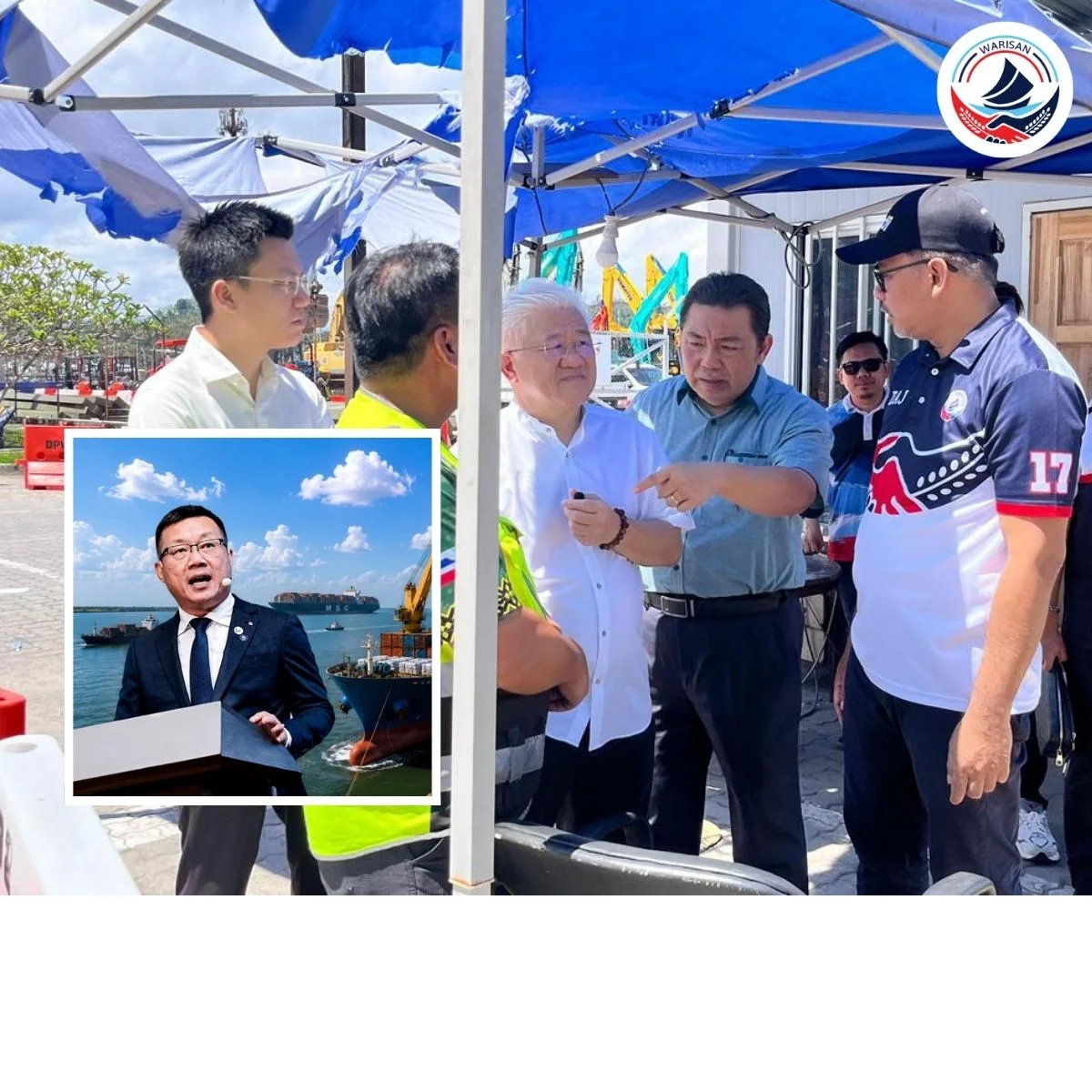
KOTA KINABALU: Congestion at Sepanggar Port is becoming increasingly severe and can no longer be regarded as a temporary disruption following recent visits and engagements with container truck drivers, logistics operators, shipping agents and affected industry players.
In a joint statement issued by Warisan Information Chief Datuk Azis Jamman, Likas Assemblyman YB Tham Yun Fook, Kapayan Assemblyman YB Chin Tek Ming and Warisan Supreme Council member KC Chen, they said the current situation shows that many industry players are now facing growing operational and financial pressures.
According to them, conditions on the ground confirm earlier claims made by the Federation of Malaysian Manufacturing (FMM) Sabah that the port is currently in a state of “paralysis” or operational breakdown.
Among the major issues raised by industry players are excessively long waiting times for container movement, congestion during gate-in and gate-out processes, delays in container clearance, shipping schedule disruptions, container rollovers, as well as increased detention and demurrage costs.
They said the situation has also led to higher transportation costs and significant disruptions across Sabah’s overall supply chain.
According to the statement, on 30 April 2026, shipping companies began imposing congestion surcharges of RM500 for 20-foot containers and RM1,000 for 40-foot containers due to operational conditions at Sepanggar Port.
They added that transportation companies and hauliers are also expected to impose additional surcharges of around RM200 for 20-foot containers and RM300 for 40-foot containers due to increased operating time and delivery delays.
They stated that all these additional costs will ultimately be passed on to businesses, small and medium enterprises (SMEs), and ordinary consumers in Sabah.
They stressed that the issue is no longer merely a port management problem, but has evolved into a serious economic issue affecting Sabah’s competitiveness, investor confidence, supply chain stability and the people’s cost of living.
According to them, Sabah’s industry players have long faced structural disadvantages compared to Peninsular Malaysia due to higher logistics and transportation costs.
The statement also noted that a shortage of operational cranes is believed to be one of the main causes of congestion at the port, based on feedback from industry players who claimed that container loading and transfer capacity is insufficient.
In addition, the lack of buffer zones, storage space and container yard capacity has further worsened congestion pressure at the port area.
In this regard, they questioned what short-term and long-term plans the state government has to resolve the crisis.
They also questioned why urgent measures such as expanding port operational areas, increasing buffer zones and acquiring additional cranes have yet to be implemented aggressively despite the increasingly obvious impact on Sabah’s economy.
According to them, if immediate action is not taken, Sabah risks losing more investment opportunities and industry confidence to other regions with more efficient and stable logistics systems.
In the same statement, they stressed that the issue should not be politicised but instead addressed urgently through coordination, transparency and practical solutions.
Among the proposals put forward are immediate operational measures to reduce container backlogs, temporary expansion of operational capacity, increased crane capacity, expansion of storage areas and better coordination between port operators, shipping companies, hauliers and logistics agencies.
They also urged the Sabah Ports Authority and related ministries to provide regular updates to the public regarding mitigation measures and operational recovery timelines.
At the same time, they also raised questions regarding the capability of the DP World-led joint venture company based in Dubai to fulfil its responsibilities amid the impact of the Iran-United States conflict on international operations.
According to them, ports are the main gateway to Sabah’s economy, and any operational weakness will directly affect manufacturers, SMEs, investors and the state’s overall economic growth.
They stressed that the people of Sabah deserve a modern, efficient and reliable logistics system that supports economic growth rather than becoming an obstacle to development.