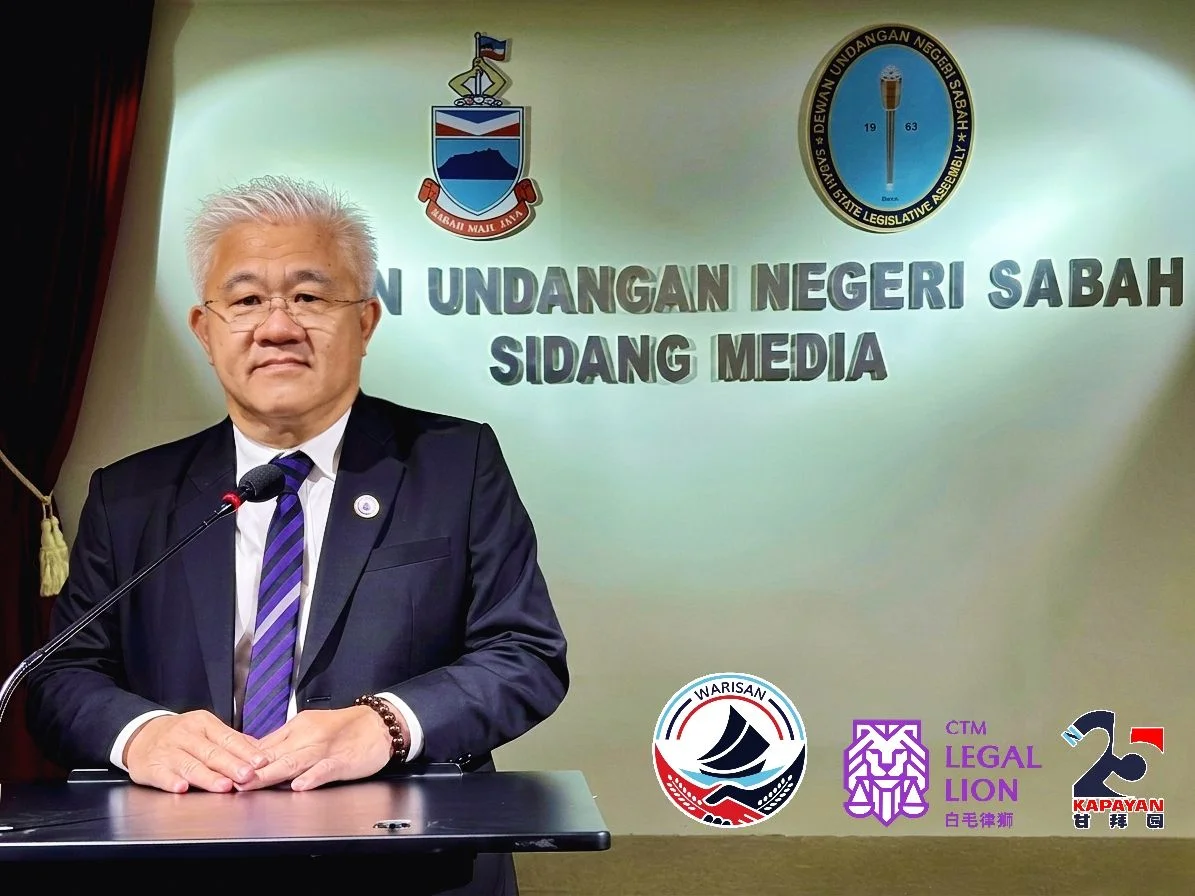
KOTA KINABALU, April 2026 — Member of the State Assembly (ADUN) for Kapayan, YB Chin Tek Ming, expressed support for the Land Bill (Subsidiary Title) 2026 in principle, but emphasized that several fundamental weaknesses need to be refined before it is approved.
In the debate at the Sabah State Assembly, he stressed that the bill still contains areas that could lead to abuse of power and undermine legal certainty.
The first major issue raised concerns Clause 8(2)(a), which refers to the term "special circumstances." According to him, the term is too vague as it lacks a clear definition, guidelines, or limits. This situation causes the interpretation to rely entirely on the discretion of the Director, thereby posing a risk of inconsistent decisions, unfair treatment, and perceptions of abuse of power.
He emphasized that in the context of the law, certainty and accountability are essential elements. Therefore, the term should be specifically defined either in the law or through subsidiary regulations with objective criteria.
Furthermore, he also raised the issue of inconsistency in Clause 8(3), which allows the approval of applications based solely on the layout plan without the requirement for a building plan and index plan. According to him, this leniency contradicts the principles of comprehensive and transparent land development management.
The absence of complete documents, he said, raises questions about the suitability of the development, buyer protection, and the risk of overlap or boundary conflicts. He suggested that the requirement for these documents be made mandatory except in clearly defined extraordinary circumstances.
The third issue addressed relates to Clause 40(9), which grants the Director the authority to dispose of property or documents that have been forfeited in a manner deemed appropriate. He described this provision as too broad and lacking any standard operating procedures (SOP), review mechanisms, or guarantees of transparency.
According to him, in a modern administrative system, asset disposal must be governed by clear, transparent, and auditable SOPs. In this regard, he proposed that the provision be amended to be subject to official guidelines and audit records.
In closing his speech, he emphasized that the issues raised revolve around one main theme: the granting of overly broad discretionary power without adequate controls. He reminded that good laws not only confer power but also set limits, guidelines, and review mechanisms.
He also urged the government to pay attention to the issue of abandoned development in Sabah, particularly in Kapayan, and to consider drafting specific laws to address this problem.
YB Chin Tek Ming stressed that while he supports this bill, amendments need to be made to ensure it truly protects the interests of the people of Sabah.