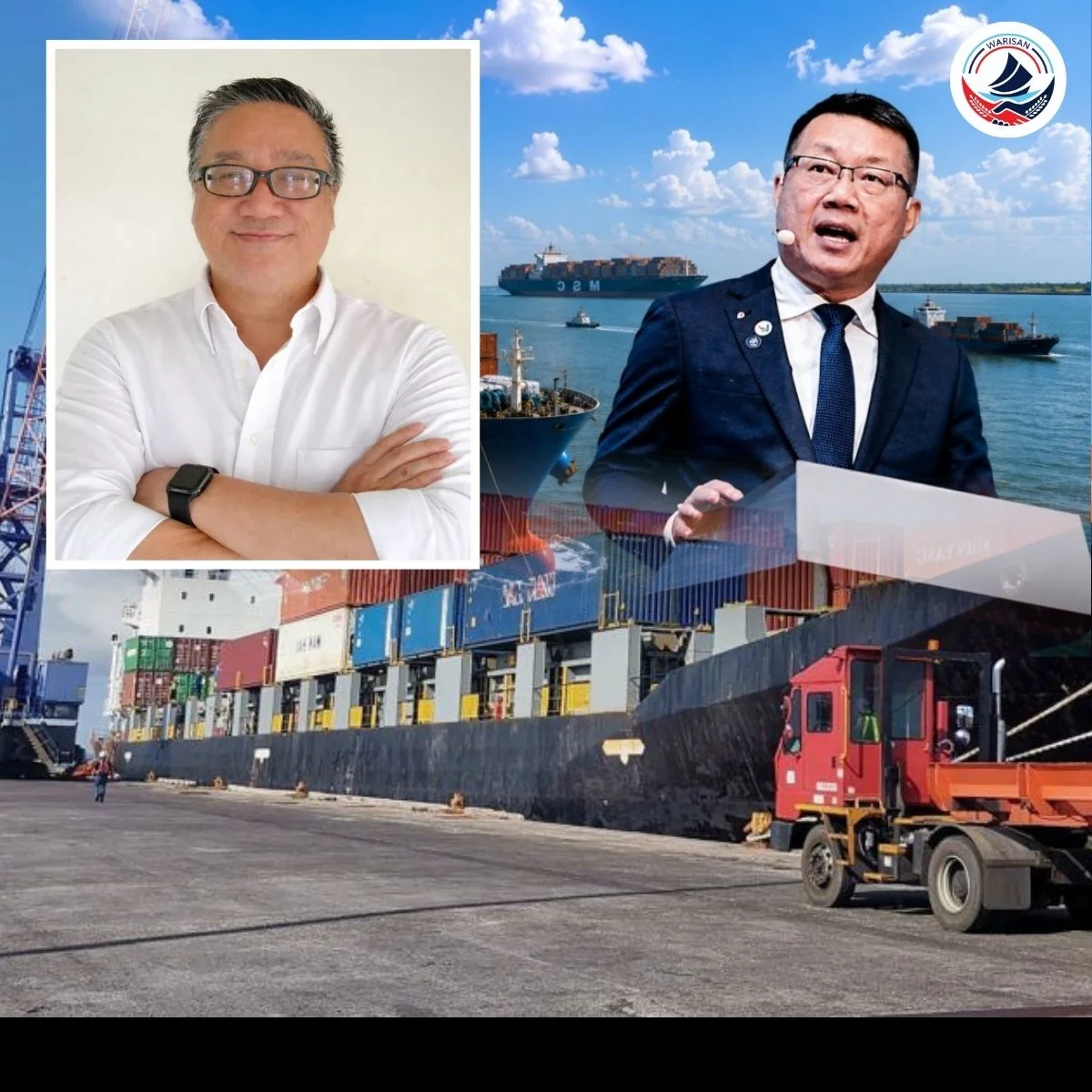
KOTA KINABALU: Warisan Strategic Communications Director, Christopher Masudal, has taken a serious view of the worsening port congestion crisis in Sabah, which is now alleged to have reached a critical level and is disrupting industrial operations, trade activities, and the state’s supply chain.
He referred to a statement by the President of the Federation of Malaysian Manufacturing (FMM) Sabah, Liaw Hen Kong, who raised concerns over the port congestion situation, which is significantly affecting industry players in Sabah.
According to Christopher, the issue is no longer merely a logistical problem but has become a direct threat to the welfare and future of key industrial sectors in the state, including agriculture, manufacturing, food processing, and commodity exports.
He said the manufacturing sector alone contributes billions of ringgit annually to Sabah’s economy, while also providing thousands of job opportunities for locals.
At the same time, he noted that Sabah is one of the country’s major producers of palm oil, cocoa, seafood, and agricultural products, all of which heavily depend on efficient port operations and cargo transport systems.
However, he alleged that weaknesses in supply chain management due to inefficiency and a lack of concern from the GRS-led state government have caused industry players and end consumers to bear rising costs.
According to him, additional surcharges caused by port congestion have now reached up to RM500 for a 20-foot container and RM1,000 for a 40-foot container, as highlighted by FMM Sabah.
He added that container transport operators are also expected to increase charges by between RM200 and RM300 per container.
He said this situation is occurring while Sabah’s industry players are already facing rising operational costs, including increases in raw material prices, electricity and utility tariffs, transportation costs, as well as higher assessment taxes and operating licence fees in several areas, including the Penampang district.
Christopher stated that all these cost increases will ultimately be passed on to consumers, resulting in higher prices for food, essential goods, and overall living costs for the people of Sabah.
He also stressed that providing diesel fleet cards to logistics operators would be meaningless if the state government itself fails to ensure that Sabah’s supply chain system functions effectively.
He added that the state government must also recognise that there are parties in Peninsular Malaysia who are constantly looking for reasons to question the Federal Government’s decision to maintain diesel subsidies in Sabah.
According to him, inefficiencies in cargo handling at Sabah ports should not become an excuse for the eventual removal of diesel subsidies in the state.
He further stated that if such a situation occurs, the entire Sabah Cabinet must take full responsibility, as FMM Sabah has openly expressed dissatisfaction over the failure to manage the crisis.
Christopher said state policies must prioritise the welfare and future of Sabah’s industry players, as they are key drivers of the state economy and providers of employment for thousands of Sabah youths.
He stressed that the issue must be urgently resolved by Chief Minister Datuk Seri Hajiji Noor and the relevant ministries, as it affects the competitiveness of Sabah’s industries compared to other states such as Sarawak and Selangor, which are aggressively strengthening their port infrastructure and logistics systems.
As a former MIDA executive officer who was involved in policy and federal government negotiations during his service at MITI, Christopher also proposed the immediate establishment of a special task force committee to address the issue comprehensively, professionally, and transparently.
He said that all discussions, findings, and decisions related to the matter should also be made public so that both the public and industry players are aware of the solutions being implemented.
He concluded that if Hajiji Noor’s Cabinet continues to fail in resolving the issue, Parti Warisan has many assemblymen and supporting officers ready to take over responsibility in order to safeguard the future of Sabah’s economy and industry.