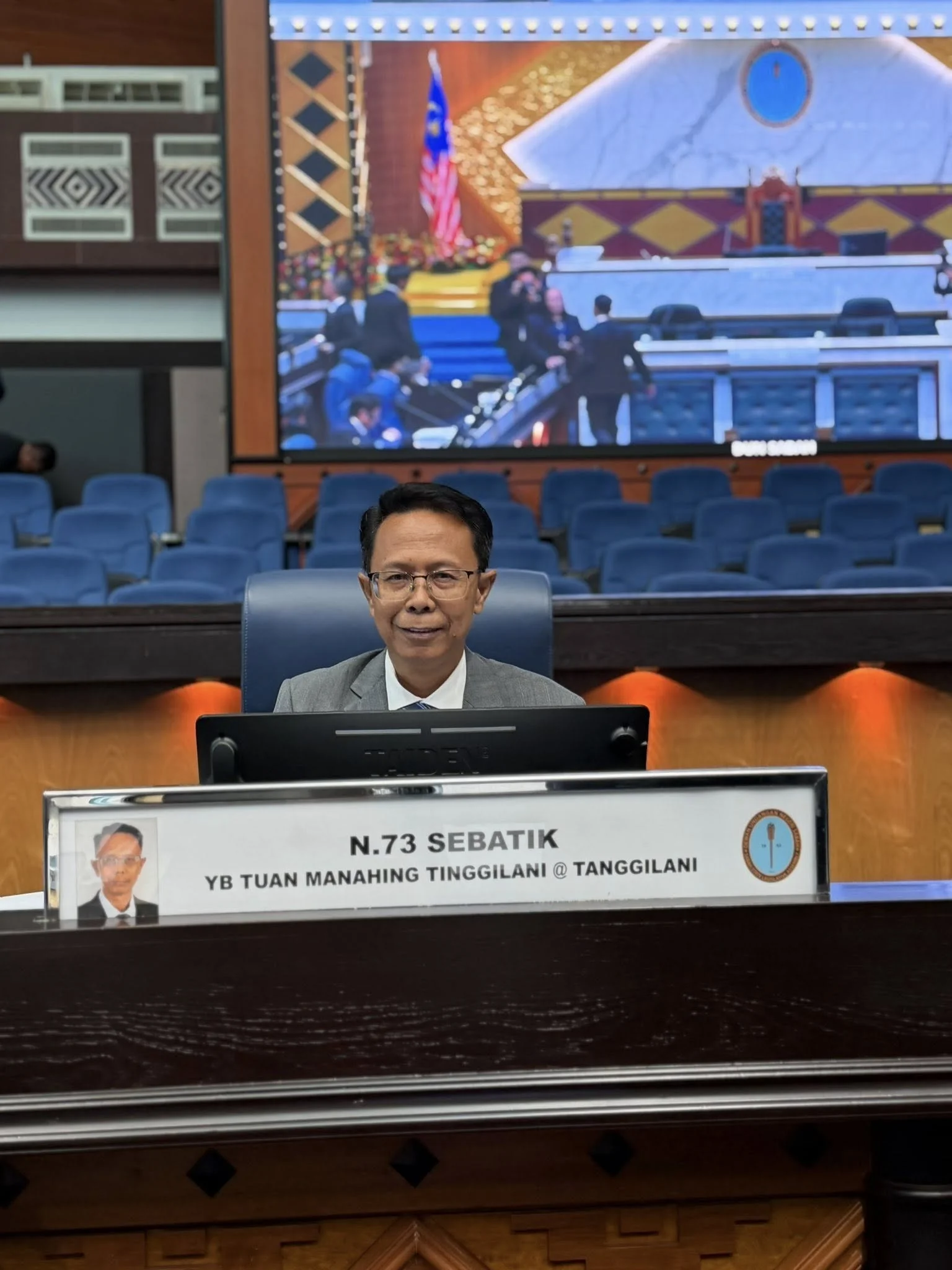
KOTA KINABALU, April 2026 - The Assemblyman for Sebatik, YB Manahing Tinggilani urged the Sabah state government to prioritize the immediate resolution of basic facilities issues that plague the people, especially in the Sebatik constituency, including clean water supply, roads, public jetties, electricity supply, and the cost of living.
While debating the government's policy speech during the Opening Ceremony and First Meeting of the Second Session of the 17th Sabah State Assembly, he stated that the people in the Sebatik area have been waiting too long for government intervention on basic facilities issues, which he described as still unresolved comprehensively.
He also questioned the state government's main focus in ensuring that the aspiration of "People's Welfare is Prioritized" can truly be achieved through the Sabah Budget 2026, which allocates an estimated expenditure of RM6.402 billion.
According to him, the welfare of the people is difficult to realize if the basic infrastructure problems remain unresolved.
Regarding the clean water supply issue, he stated that the areas of Pulau Sebatik, Kalabakan, Felda Umas, Luasong, Serudung Laut, Brantian, and Sungai Udin continue to face critical problems due to reliance on rainwater sources, especially during the dry season and the Southwest Monsoon from May to September.
He mentioned that the forecast of increased intensity of the El-Nino phenomenon this year is expected to worsen the situation and described the water problem in the area as having persisted for more than six decades without a comprehensive solution.
For a long-term solution, he suggested that the existing dam in Pulau Sebatik be dredged back to its original specification of 17 meters deep, in addition to strengthening the surrounding dam embankment.
He stated that based on previous written answers from the government, the Sabah State Water Department (JANS) plans to implement a deepening and dredging project for the water reservoir at the Pulau Sebatik Water Treatment Plant to increase water source capacity and hopes that the project will be expedited.
For short-term measures, he suggested that static tanks be placed in every village to facilitate water distribution during the dry season, along with continuous monitoring of pipe damage and leaks.
He also proposed the implementation of cloud seeding by MetMalaysia if the dry season persists to increase water capacity in the Wallace Bay dam area.
Meanwhile, he raised the issue of road damage, particularly on the Merotai-Kalabakan route, which he described as dangerous due to the pressure from overloaded heavy vehicles and construction quality factors.
He stated that this situation not only causes vehicle damage but also endangers the lives of road users.
He also expressed concern over the road embankment collapses in the Sebatik constituency, which he deemed very dangerous, especially at night due to the absence of street lights.
In addition, he informed that the new road project from Kampung Bergosong to Sungai Pukul, Sungai Melayu, and several other villages is progressing too slowly, leading to complaints from residents.
Regarding public jetty facilities, he stated that most jetty structures in the Sebatik constituency are in a dilapidated condition and unsafe for use.
He informed that the SMK Wallace Bay Jetty completely collapsed on March 22 and suggested that all wooden jetties in the area be upgraded to concrete jetties complete with waiting shelters, solar lights, and better landing facilities.
Touching on the electricity supply issue, he said that supply disruptions often occur due to unstable voltage, especially during bad weather.
According to him, several areas such as Kampung Mukandot and Serudung Laut still rely on private generators because they have not received electricity supply from Sabah Electricity.
He suggested that the use of renewable energy based on hybrid solar systems be expanded to rural areas as a more environmentally friendly short-term solution.
In another development, he also raised the issue of village status in Kampung Mukandot, which he said has been applying for the declaration of the settlement area since 1985 but has yet to be finalized.
He stated that the increase in population and the existence of second and third generations require the government to expedite the land declaration process and the settlement of residents in Mukandot and Luasong.
Touching on the cost of living issue, he said that the people of Sabah continue to feel the pressure from rising prices of goods and global supply chain disruptions.
He also brought the voice of sea transport boat operators in Pulau Sebatik, requesting that the Ministry of Domestic Trade consider a special fuel quota and subsidy to control transportation costs for passengers and essential goods.
He questioned the effectiveness of the Sabah Maju Jaya (SMJ) Plan in ensuring food security, in addition to calling for drastic measures to be taken to reduce dependence on food imports to stabilize prices.
In the same speech, he also raised the issue of international boundary delineation between Malaysia and Indonesia, particularly in Pulau Sebatik and the areas of Sungai Sinapad and Sungai Sesai in Pensiangan.
He stated that the Outstanding Boundary Problems (OBP) between Malaysia and Indonesia involve aspects of territorial sovereignty, security, residency rights, and regional economic stability.
He referred to the Memorandum of Understanding (MoU) dated February 18, 2025, which finalized the boundary line between Sabah and North Kalimantan and Pulau Sebatik.
However, he questioned the claims on social media and statements from the Chief of Staff of the Indonesian President that an area of 127.3 hectares in Pulau Sebatik is now owned by Indonesia, in addition to disputes involving an area of 5,987 hectares in Sungai Sinapad and Sungai Sesai.
In this regard, he requested clarification from the state government regarding the actual situation in the area along Latitude 4°10’ North in Pulau Sebatik, the validity of social media reports related to the boundary, and the level of state government involvement in the international boundary finalization process involving the Sabah region.
Concluding the debate, he emphasized that the majority of issues raised by assembly members revolve around basic facilities and the cost of living, which he stated have yet to meet the necessary standards to ensure the welfare of the people of Sabah.